Hzera uses clinically researched sound therapy — including notch filtering and Coordinated Reset neuromodulation — to target your exact tinnitus frequency. Calibrate in minutes, listen daily, and let your brain do the rest.
Millions of people hear a constant ringing, buzzing, or hissing that no one else can hear. Tinnitus isn't a disease — it's how the brain processes sound when something changes in the auditory system.
An estimated 15–20% of people experience some form of tinnitus. For many, it's most noticeable in quiet environments — making bedtime, focus work, and relaxation the hardest parts of the day.
Stress, fatigue, caffeine, and loud noise exposure can all temporarily worsen the perception. But the underlying cause is usually neural: the brain's auditory cortex amplifying signals that aren't there.
That's where retraining comes in. The brain created the pattern — and with the right approach, the brain can learn to quiet it.
Experience some form of tinnitus — you are far from alone in this.
Tinnitus often feels louder in quiet environments, disrupting sleep and concentration.
Tinnitus is generated by overactive neurons in the auditory cortex — and the brain can be retrained.
Notch therapy and Coordinated Reset are grounded in peer-reviewed neuroscience research from leading universities.
Hzera combines multiple clinically researched methods into a single, easy-to-use therapy experience.
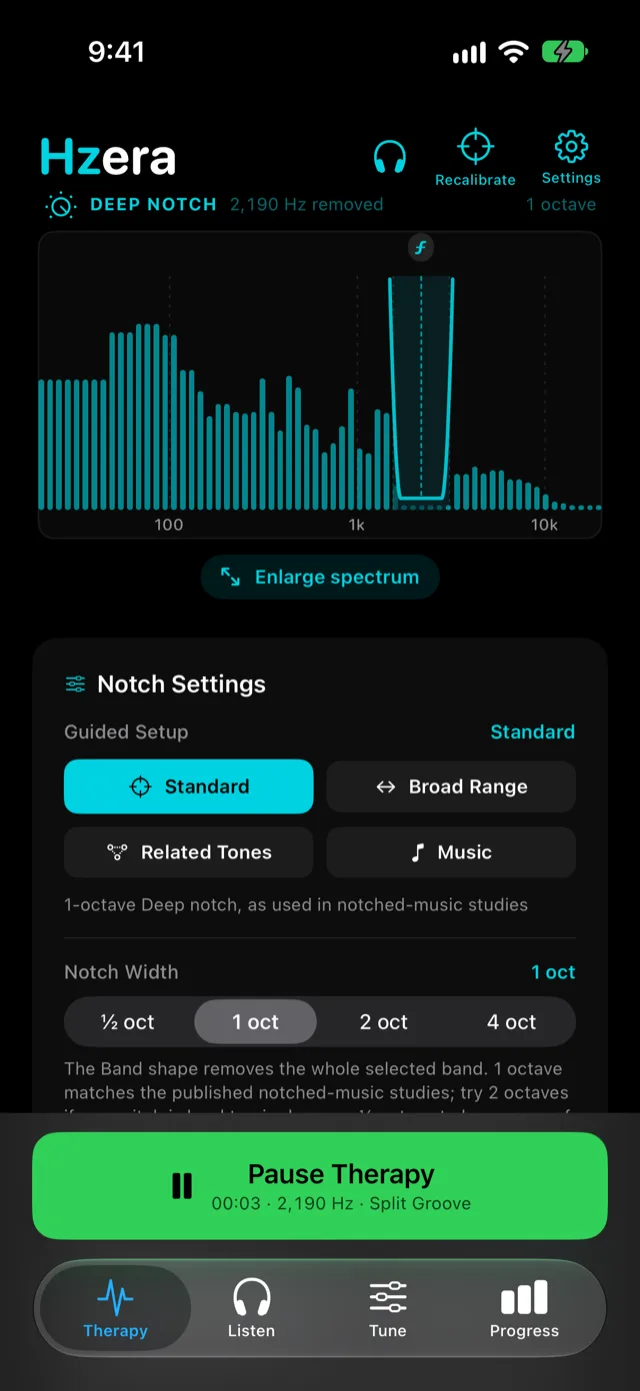
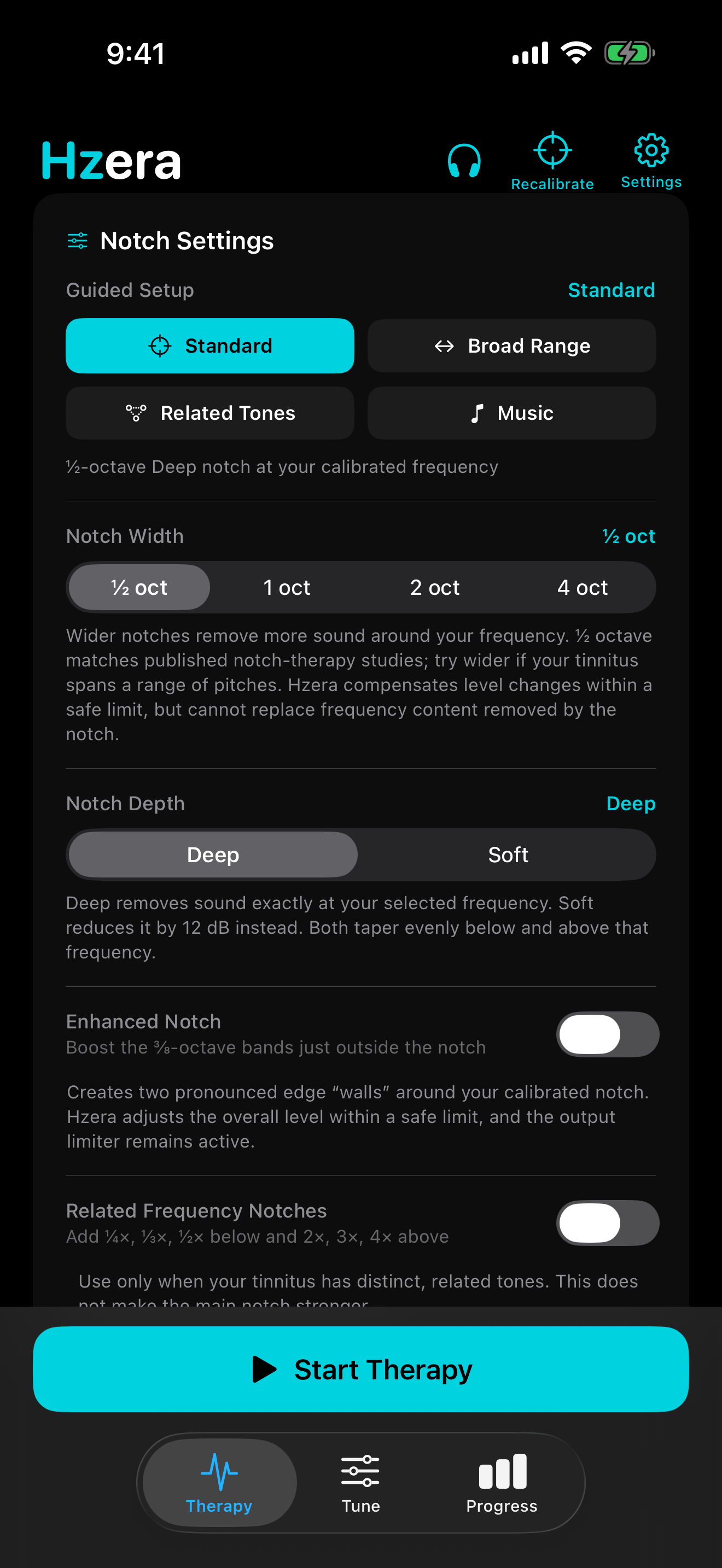
The core of Hzera. A narrow frequency band (~4.5% bandwidth) is precisely removed from your chosen soundscape at your tinnitus frequency. This "notch" triggers lateral inhibition — neighbouring neurons suppress the overactive ones responsible for your phantom sound. Over weeks of regular listening, neural activity at your tinnitus frequency decreases.
Lateral InhibitionBased on the Jastreboff model, therapeutic sound is played just below your tinnitus perception level. Over time, your brain learns to classify tinnitus as unimportant background noise, reducing both the perceived loudness and the emotional distress associated with it by calming the limbic system response.
Jastreboff ModelHzera generates organic, never-repeating sound patterns using fractal algorithms. These complex textures keep the auditory cortex gently engaged, reducing the brain's ability to fixate on the tinnitus signal — without causing habituation from repetitive loops.
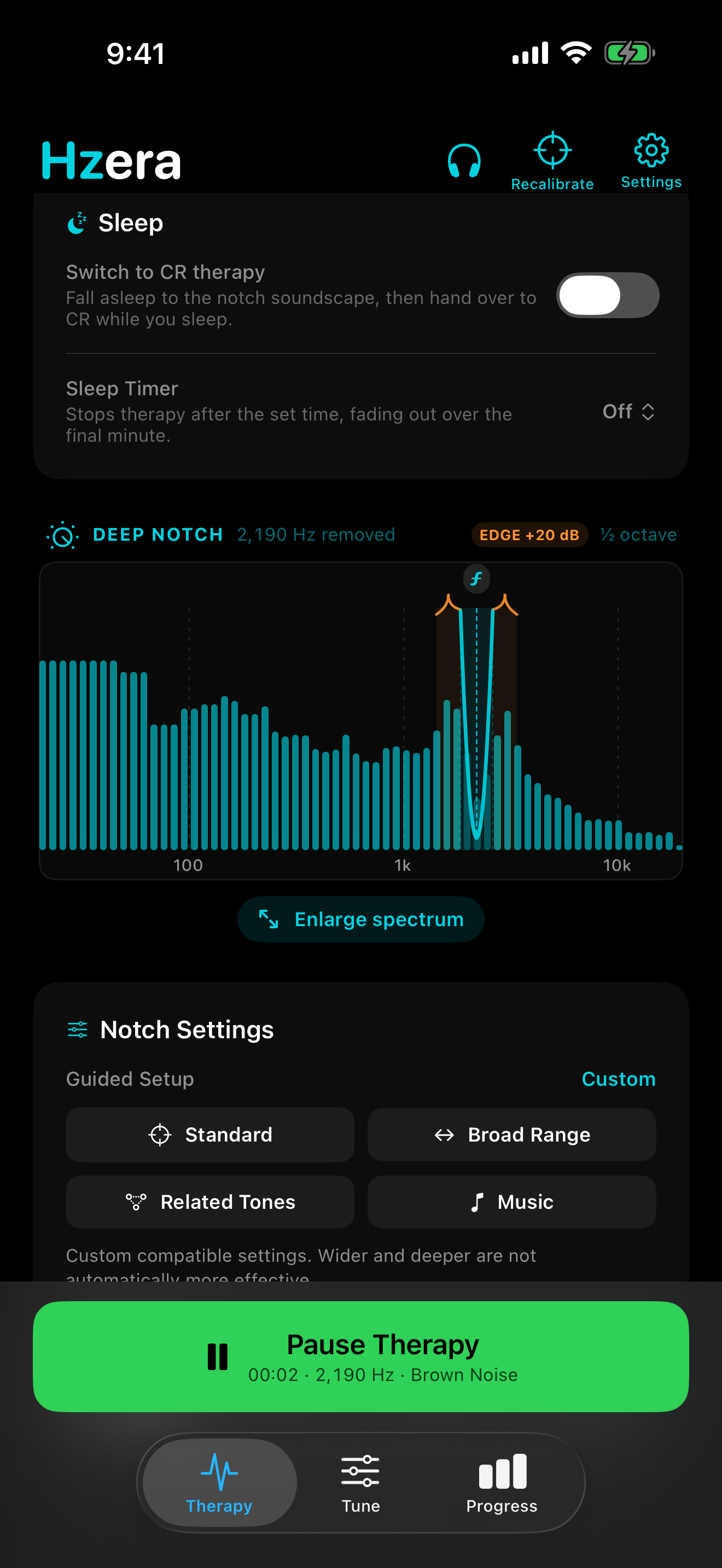
Neural EngagementA specialised neuromodulation approach that plays four precisely tuned tones clustered around your tinnitus frequency in randomised sequences. Each cycle delivers tones at different offsets, disrupting the abnormal synchronised neural firing patterns that sustain tinnitus. Over time, CR helps the brain's auditory neurons return to healthy, desynchronised activity.
Neural DesynchronizationTinnitus often presents differently in each ear. Hzera supports independent left and right channel calibration, applying separate notch filters to each ear. This maximises the lateral inhibition effect exactly where it's needed, addressing bilateral asymmetry with precision.
Bilateral PrecisionHow the notch filter works — your tinnitus frequency is removed from the soundscape
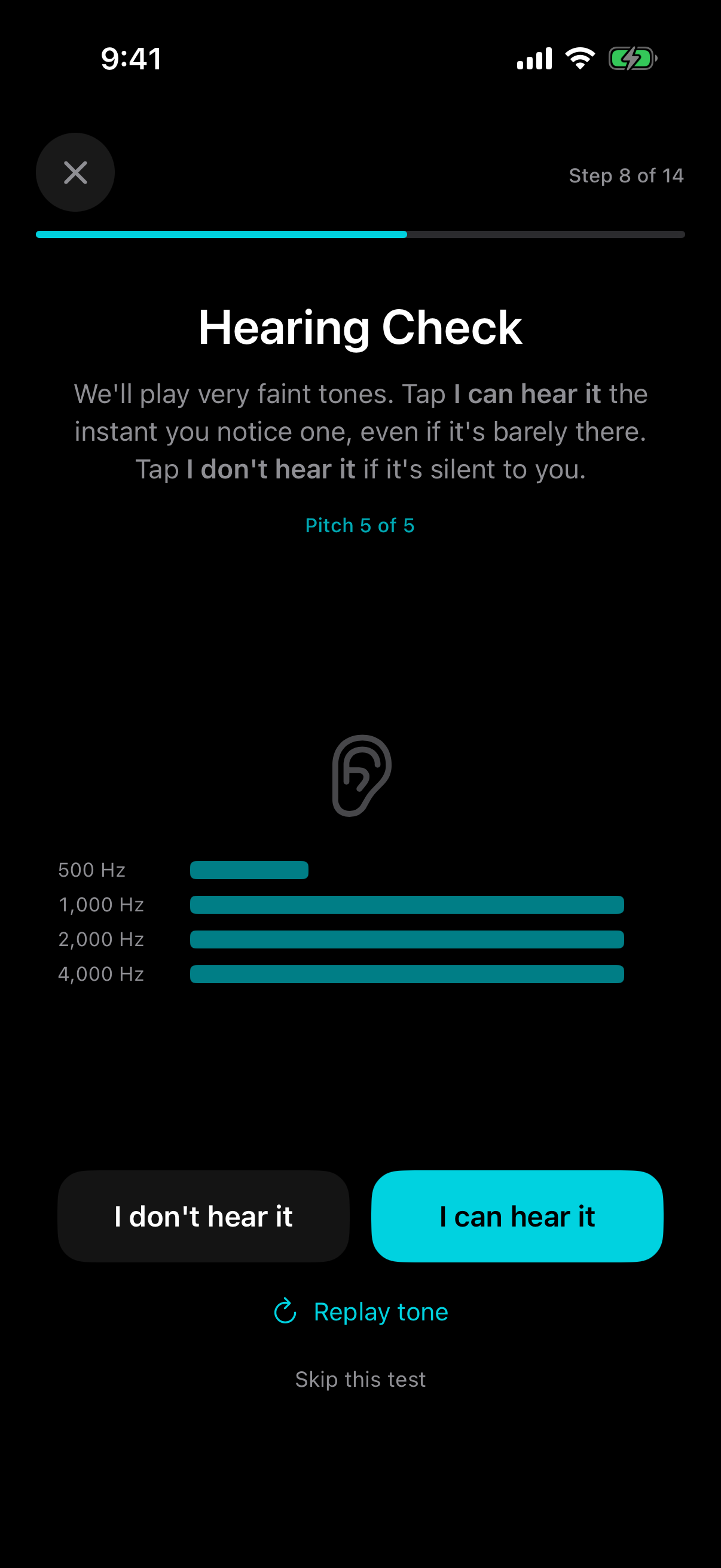
Hzera's guided onboarding walks you through a clinically informed process to identify your exact tinnitus frequency — no specialist equipment needed.
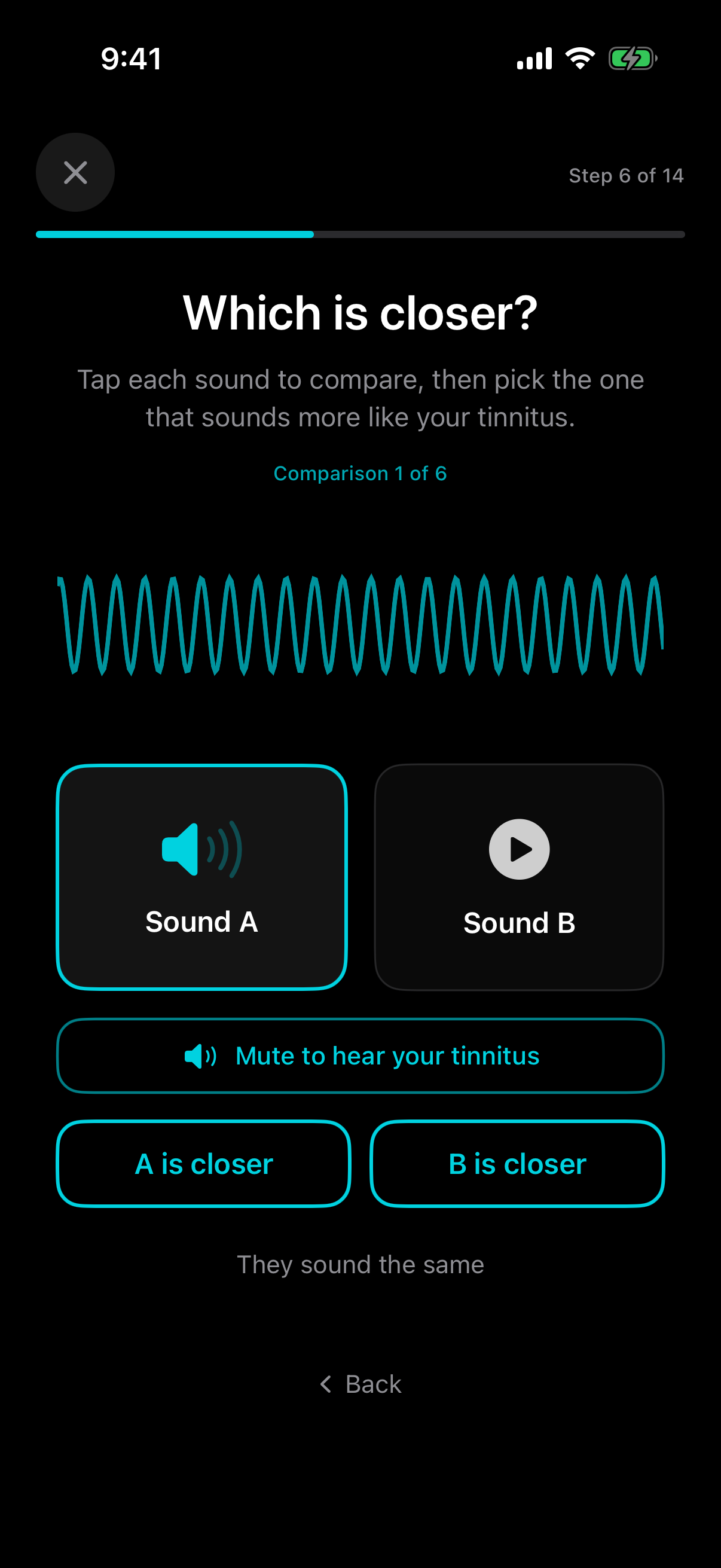
A guided two-stage process: first, a coarse sweep across the full 20 Hz – 20 kHz spectrum to narrow the range, then fine-tuning in precise 5 Hz increments to pinpoint your exact tinnitus pitch.
FreeA 10-question tinnitus handicap inventory evaluating sound type, duration, pattern, affected ears, and daily life impact. Generates a severity score (0–40) across five clinical grades from Slight to Catastrophic.
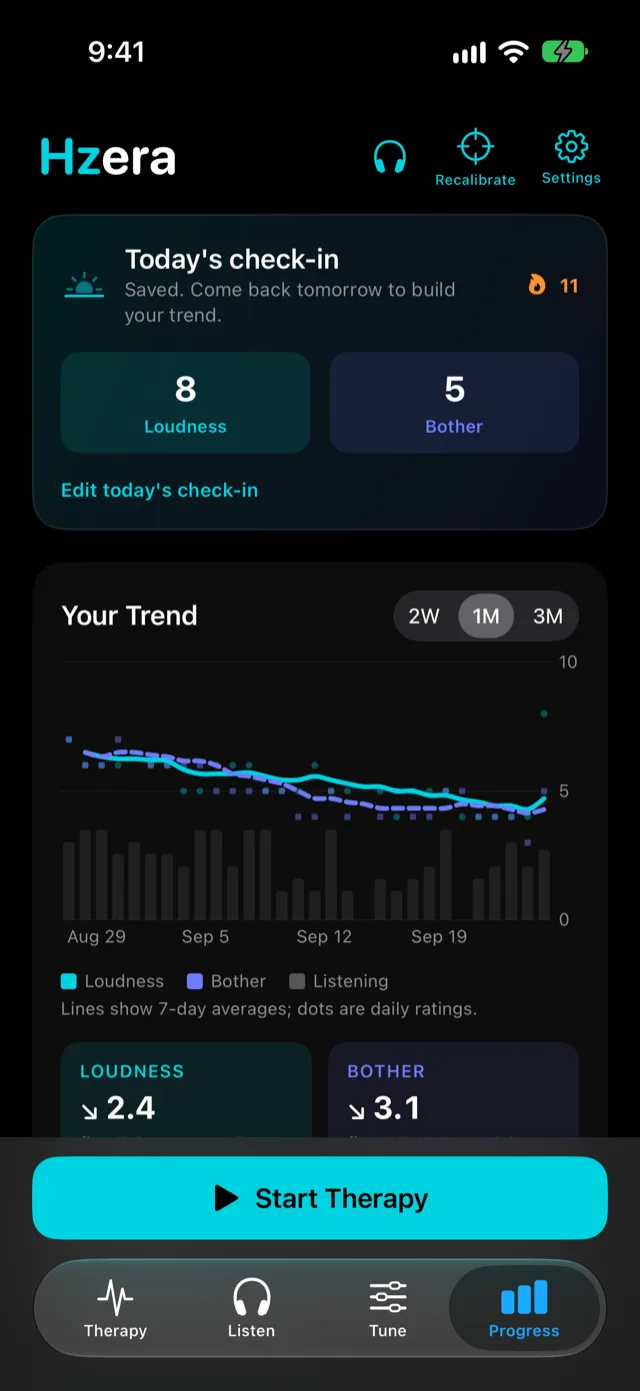
FreeEvery therapy session is logged with duration, frequency, and soundscape choice. View weekly trends, build listening streaks, and track total therapy time to stay consistent with your retraining.
FreeYour score guides personalised recommendations — from self-monitoring to professional referral.
Minimal impact. Monitoring recommended.
Noticed mostly in quiet environments.
Noticeable impact on daily life.
Professional consultation recommended.
Immediate professional support needed.
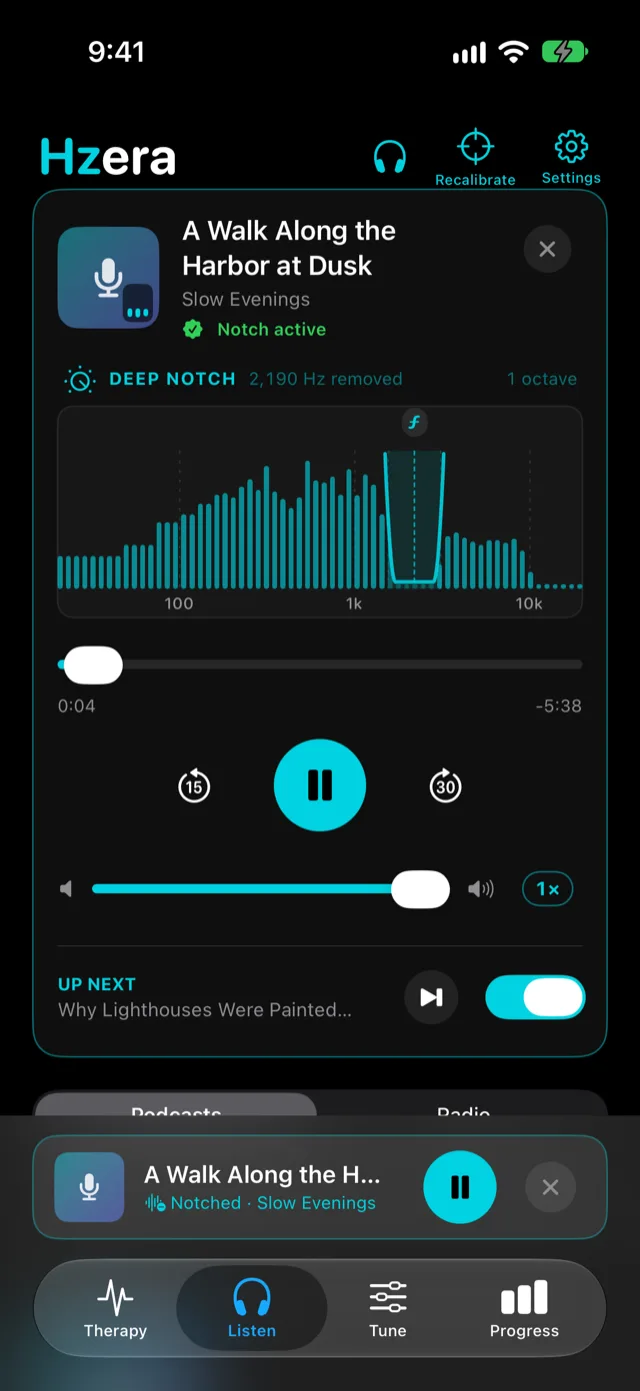
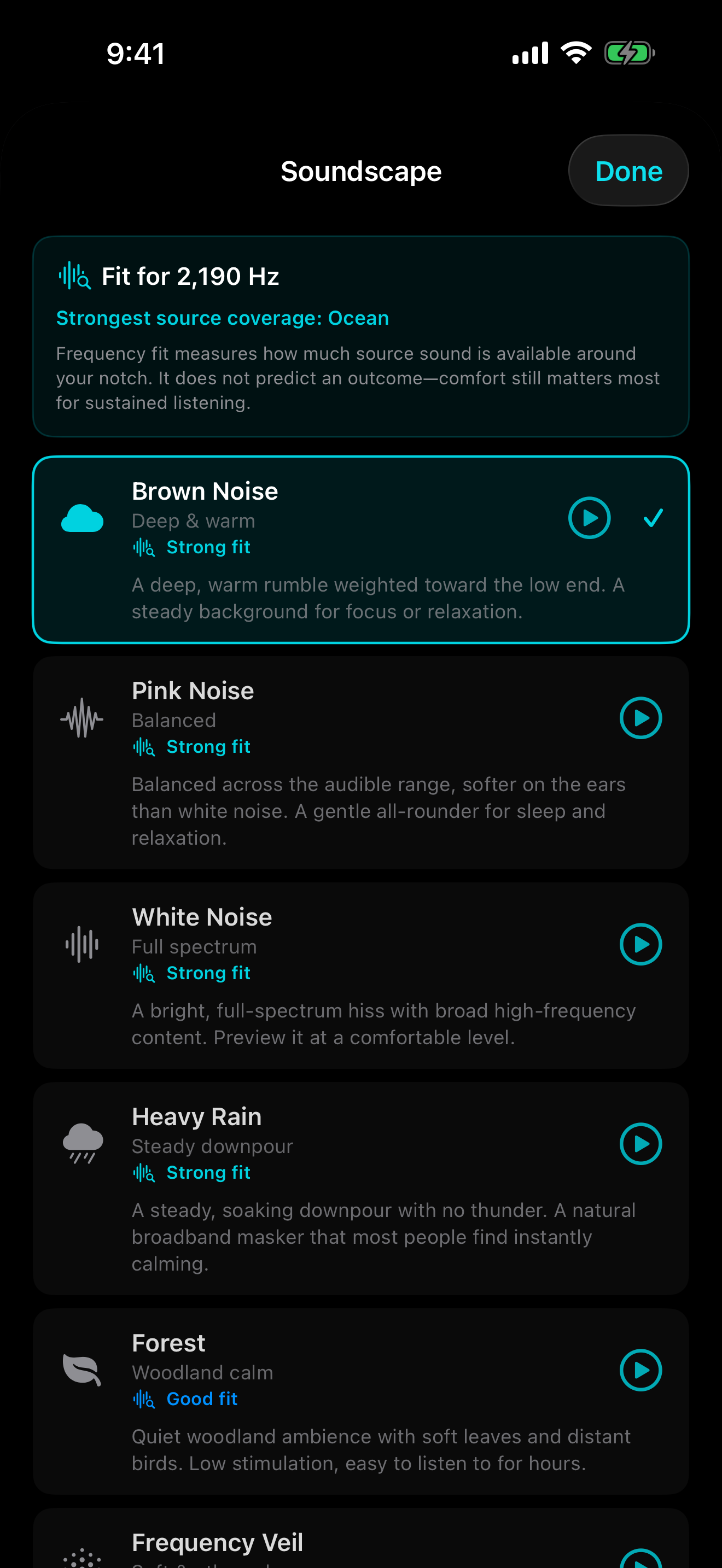
Each soundscape has your personalised notch filter applied in real time. Pick the ones you enjoy, or import your own audio files — longer listening means better outcomes.
Deep & warm
FreeBalanced
FreeFull spectrum
FreeSteady downpour
FreeWoodland calm
FreeSoft & ethereal
PremiumWarm bloom
PremiumDeep cascade
PremiumAmbient terminal
PremiumBirdsong
PremiumCrackling warmth
PremiumRolling waves
PremiumDistant rumble
PremiumSynthetic pulse
PremiumFlowing water
PremiumImport MP3, M4A, WAV & more
PremiumDesigned for daily use — simple enough for a first session, powerful enough for months of therapy.
Full 20 Hz – 20 kHz range with 5 Hz fine-tuning. Quick Tune lets you recalibrate any time your tinnitus changes.
All data stays on your device. No accounts, no analytics, no tracking. Works entirely offline after install.
Fall asleep to therapy. Set a timer from 15 to 120 minutes and the app gently fades out automatically.
Consistency is key. Set personalised reminders to keep your therapy streak going strong.
Weekly trends, streak tracking, total listening time, and detailed soundscape breakdowns to monitor progress.
See your elapsed therapy time directly in the playback bar. Daily goal tracking and streak counters keep you motivated and consistent.
No subscriptions. One price. Lifetime access.
A complete tinnitus therapy tool at no cost.
Unlock every feature with a single payment.
Results come with consistency. Here's what the science says about the timeline.
Your brain begins adapting to the notch-filtered sound. Many people notice improved relaxation and sleep quality even before tinnitus volume changes.
Lateral inhibition strengthens. Most users report tinnitus becoming less noticeable during this period. Consistency of 1–2 hours daily accelerates results.
Sustained retraining leads to long-term changes in auditory cortex activity. The brain progressively reduces amplification of the tinnitus signal.
Listen while working, reading, or relaxing — therapy works in the background. Pair it with an existing habit for the easiest consistency.
Listening before bed is especially effective. The brain continues processing therapeutic sound during sleep, amplifying the retraining effect.
Use headphones for maximum precision — over-ear headphones are most comfortable for long sessions. The notch filter is tuned specifically for your ears.
The Jastreboff neurophysiological model explains why tinnitus gets stuck — and reveals exactly how to unstick it.
In the 1990s, neuroscientist Dr. Pawel Jastreboff made a breakthrough discovery: tinnitus doesn't persist because of your ears alone. It persists because your brain's emotional and survival systems get involved, turning a faint signal into something impossible to ignore.
Here's how it works. When your auditory system first produces a phantom sound, your brain's limbic system — the part that controls emotions like fear and anxiety — flags it as a threat. Your fight-or-flight response kicks in. Your brain starts paying more attention to the sound, which makes it feel louder, which triggers more anxiety. A vicious cycle takes hold.
Think of it like a smoke alarm that won't stop beeping. The alarm itself isn't dangerous. But the longer it goes off, the more stressed you become, and the harder it is to tune out. Your brain needs to learn that this particular signal is not a real threat.
That's exactly what Hzera helps your brain do.
Damaged hair cells in the inner ear — or overactive neurons — produce a phantom sound. On its own, it's faint and harmless.
Your limbic system labels the sound as important. Stress hormones fire. Your brain starts actively listening for it — making it louder and harder to escape.
Attention and anxiety feed each other. The more you notice the ringing, the more your brain amplifies it. This loop is what makes tinnitus feel relentless.
Therapeutic sound retrains your brain to reclassify tinnitus as background noise — like learning to ignore the hum of a refrigerator or the feel of clothes on your skin.
Hzera applies the Jastreboff model through three complementary mechanisms — all working automatically while you listen.
By removing your exact tinnitus frequency from the soundscape, Hzera reduces neural activity at that pitch through lateral inhibition. Over weeks of listening, the neurons generating the phantom sound become less active — weakening the signal where it starts.
Continuous, pleasant background sound reduces the contrast between your tinnitus and silence. When the ringing is no longer the loudest thing in the room, your limbic system stops treating it as a threat. The anxiety cycle breaks, and habituation begins.
Four tones at precise offsets around your tinnitus frequency are delivered in randomised sequences. This targeted stimulation disrupts the locked-in neural firing patterns that maintain the phantom sound, helping your auditory cortex return to normal activity over time.
Treating tinnitus is only half the equation. Preventing further damage is just as important — and much easier than you think.
A typical concert hits 100–115 decibels. At that level, permanent hearing damage can start in under 15 minutes. Clubs, festivals, sporting events, even movie theatres — any environment where you have to shout to be heard is loud enough to cause real harm.
The damage is cumulative and invisible. You won't feel it happening. But each exposure kills more of the delicate hair cells in your inner ear — cells that can never grow back. Over time, this hearing loss can trigger or worsen tinnitus.
The good news? A quality pair of earplugs changes everything. Modern earplugs reduce volume evenly across all frequencies, so the music still sounds great, conversations are still clear, but your ears are protected.
We recommend Loop earplugs for concerts, festivals, clubs, and any persistently loud environment. They use acoustic filters to reduce volume while preserving the full richness of the sound around you.
Have a question, found a bug, or need guidance with your therapy? Reach out any time.
We aim to respond within 24 hours.
Hzera is not a medical device and does not claim to cure tinnitus. If your tinnitus is severe, please consult an audiologist or ENT specialist. Sound therapy can be a helpful complement to professional care.