Guided Setup
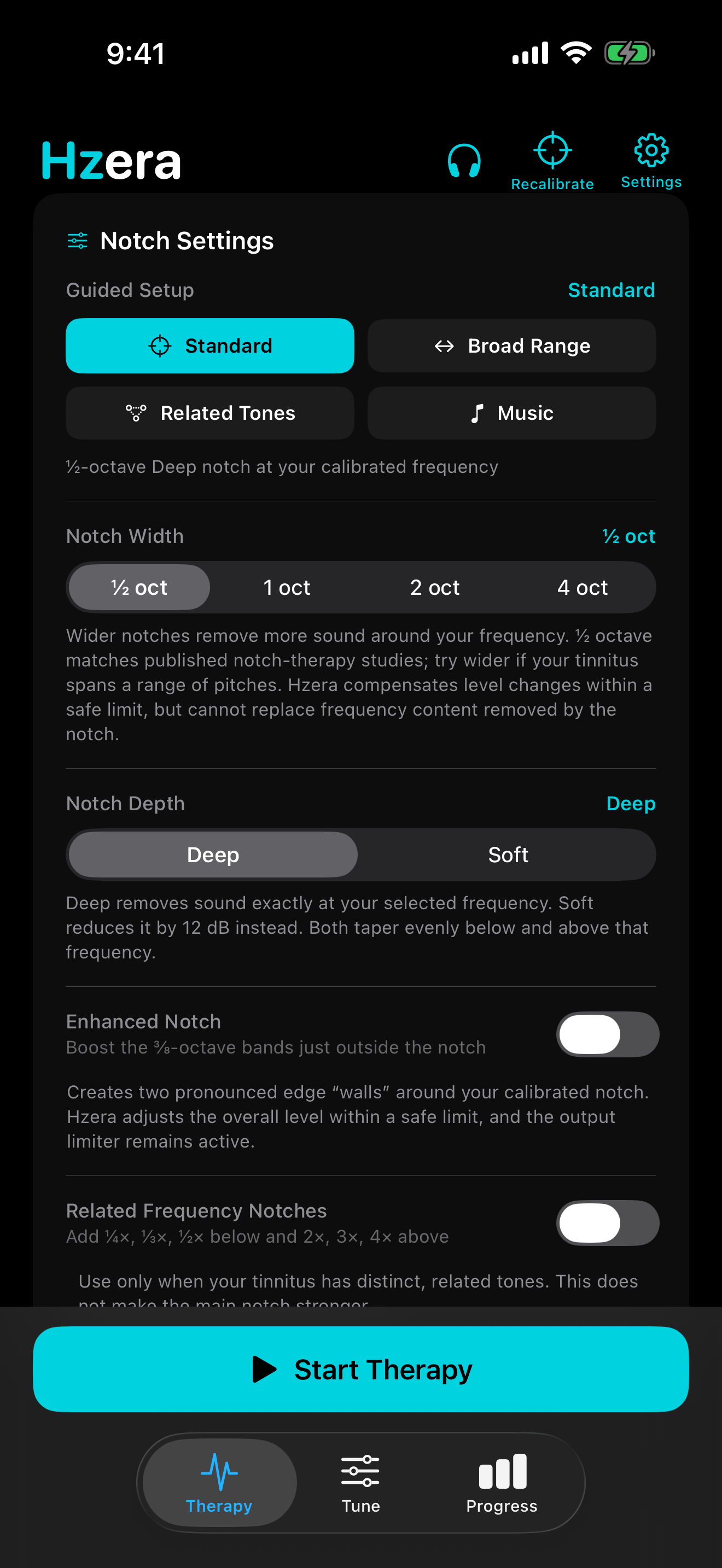
Start with Standard, Broad Range, Related Tones, or Music. Each preset chooses a compatible configuration without presenting advanced options as ranked strengths.
Hzera pairs an on-device tinnitus assessment with two customizable listening modes. Characterize your pitch, then explore real-time notch filtering or a four-tone Coordinated Reset sound pattern. No account, no subscription, and no promised miracle.
Free to download. Premium is a single $4.99 unlock, yours for life. That's less than one month of a typical tinnitus subscription app.
V2.3 makes advanced notch controls easier to understand, helps you choose suitable source audio, and makes sound switching and per-ear playback more dependable.
Start with Standard, Broad Range, Related Tones, or Music. Each preset chooses a compatible configuration without presenting advanced options as ranked strengths.
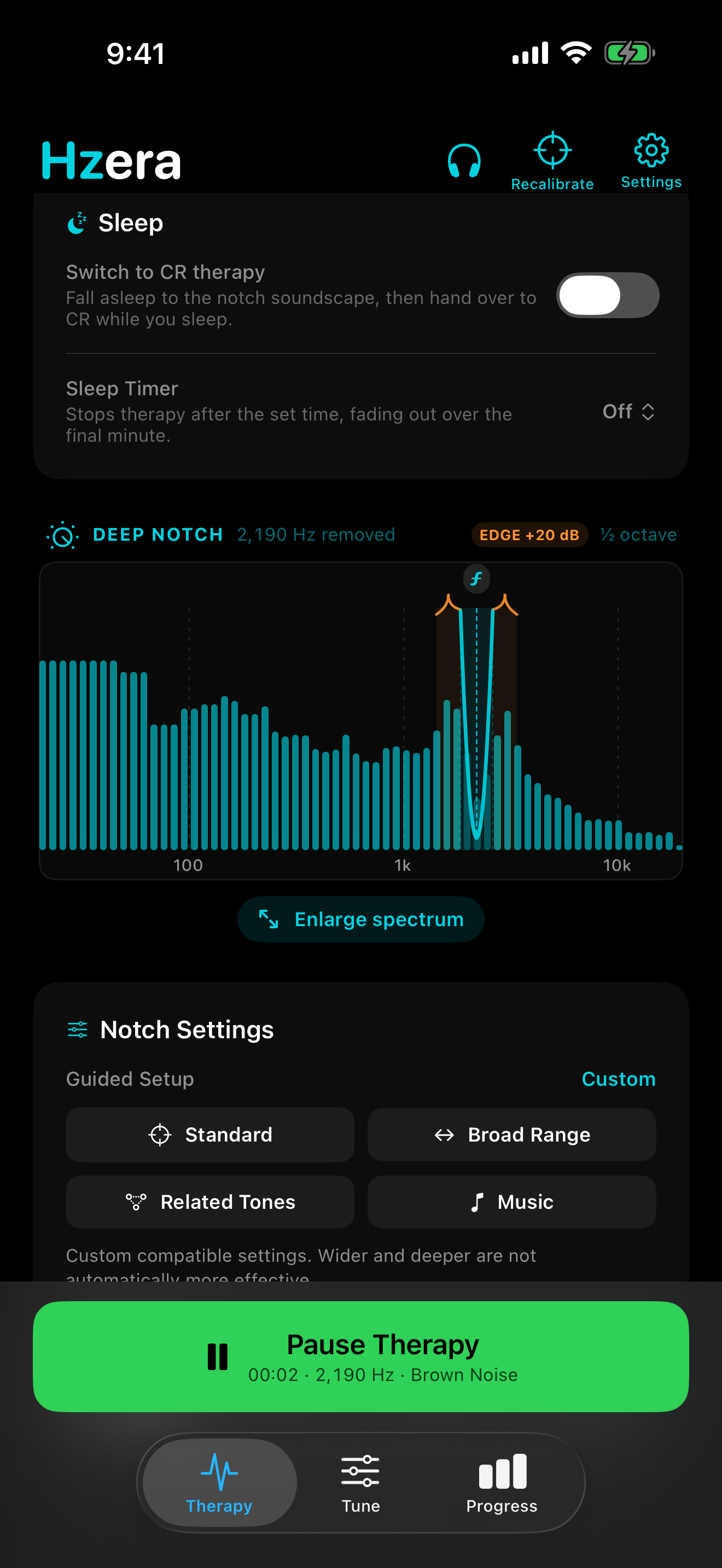
Add two narrow energy bands immediately outside the calibrated notch for stronger spectral edge contrast, visible live in the spectrum.
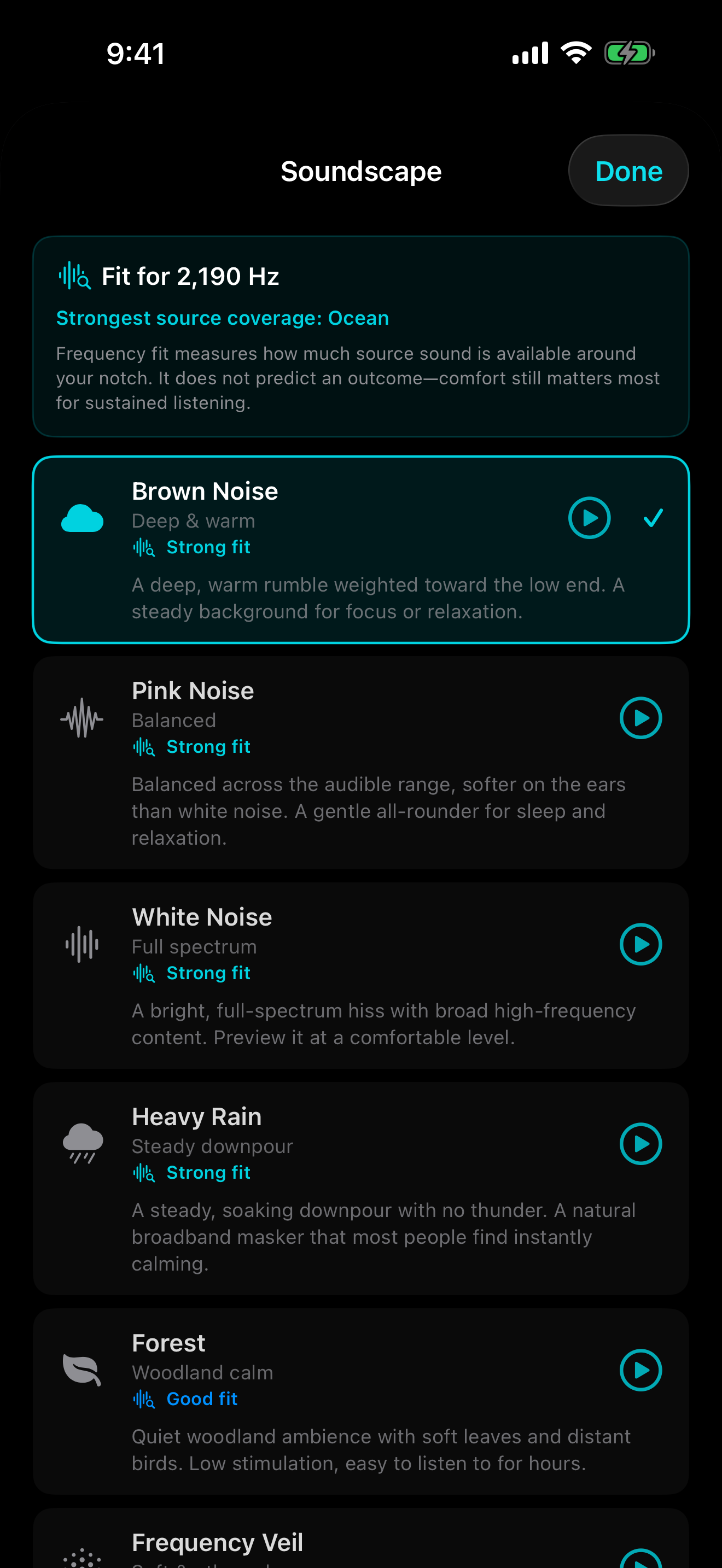
See how much left- and right-channel source energy is available around your calibrated notch. It helps compare sounds; it does not predict an outcome.
Soundscape changes now take effect while listening, per-ear channels start together, and audio streams from disk for steadier long sessions.
Millions of people hear a constant ringing, buzzing, or hissing that no one else can hear. Tinnitus isn't a disease, it's how the brain processes sound when something changes in the auditory system.
An estimated 15–20% of people experience some form of tinnitus. For many, it's most noticeable in quiet environments, making bedtime, focus work, and relaxation the hardest parts of the day.
Stress, fatigue, sleep, and noise exposure can coincide with changes in perception. Tinnitus has many possible contributors, and an app cannot determine its cause.
There is no universal cure, but evidence-based support and management options can reduce its impact for many people. Hzera provides self-guided sound tools and tracking, while clearly directing medical concerns to qualified clinicians.
Experience some form of tinnitus, you are far from alone in this.
Tinnitus often feels louder in quiet environments, disrupting sleep and concentration.
Research links tinnitus to changes across the ear, auditory pathways, and brain. Its causes and experience vary from person to person.
Hzera draws on published work in sound therapy, while being clear that evidence is still developing and individual results vary.
Most tinnitus is benign. A few presentations deserve a prompt medical opinion before you spend time on any self-help tool, including this one.
Hzera is a sound therapy tool, not a diagnosis. Research has explored how changes in auditory processing may contribute to tinnitus, and Hzera turns two of those research concepts into adjustable listening tools.
A small number of presentations point to something a clinician should look at first, and some of them are time-sensitive. Sudden hearing loss, for example, is treated most effectively within days, so waiting to see if an app helps is the wrong first move.
Hzera's built-in diagnostic screens for these patterns and will tell you the same thing if it spots one. If any of these describe your tinnitus, please get it checked before starting therapy.
We'd rather lose a customer than have you delay a diagnosis.
Hzera turns research concepts into transparent, adjustable sound tools while being honest that the clinical evidence is mixed and individual outcomes vary.
A frequency band, half an octave by default, is removed from your chosen soundscape at the calibrated tinnitus pitch. Published studies have explored lateral inhibition as a possible mechanism, but findings are mixed and Hzera does not promise symptom reduction.
Listening Mode · Notch FilteringHzera lets you keep comfortable background sound below or around the prominence of your tinnitus rather than overpowering it. This is a self-guided listening feature, not a complete clinician-delivered Tinnitus Retraining Therapy program.
Listening Principle · Comfortable Background SoundGuided Setup offers Standard, Broad Range, Related Tones, and Music starting configurations. The research-used ½-octave default can be widened deliberately, Deep or Soft controls center depth, and Enhanced Notch raises two narrow edge bands. Related-frequency banks remain limited to ½ octave so overlapping filters cannot strip most audible sound.
Notch Option · Width, Enhanced Edges, Related Frequencies, DepthA four-tone sound pattern placed around the calibrated tinnitus frequency and delivered in varied sequences. It is based on an experimental neural-desynchronization concept; evidence for lasting individual benefit remains evolving.
Listening Mode · Four-Tone PatternTinnitus can present differently in each ear. Hzera supports independent left and right notch frequencies, synchronized dual-channel playback, and a balance control that adjusts relative level without changing either filter.
Notch Option · Bilateral PrecisionIf background sound helps you settle, Sleep Mode starts with a soothing notch soundscape, then crosses gently into Coordinated Reset after a delay you choose and keeps playing until you stop it.
Therapy Delivery · Notch, then CRIncreased Spectral Energy Contrast Tailor-Made Notched Music
Standard tailor-made notched music removes a frequency band centred on a person's matched tinnitus pitch. ISEC-TMNM adds two raised bands immediately outside that notch, making the contrast at its lower and upper edges more pronounced.
Centre the notch on your calibrated tinnitus frequency.
Remove a ½-octave band around that centre frequency.
Raise two ⅜-octave edge bands by 20 dB to increase spectral contrast.
Hzera's Enhanced Notch follows this frequency layout, then automatically normalizes the overall level and applies it independently to each ear when per-ear calibration is enabled.
A small 2015 study of 18 people found reduced perceived tinnitus loudness after three days with both conventional and increased-contrast notched music. The increased-contrast version did not produce a statistically greater loudness reduction, but it was associated with stronger changes in measured cortical activity.
A later randomized study of 100 people found no benefit on its primary outcomes immediately after three months of listening, although tinnitus loudness was lower at the one-month follow-up. The protocol is promising, but the clinical evidence remains early and mixed.
Hzera is a wellness tool, not a medical device. Enhanced Notch is an optional listening feature and is not presented as a cure or guaranteed treatment for tinnitus.
Spectral contrast around the tinnitus pitch
The added energy sits beside the removed frequencies, preserving more presence in music and imported audio while keeping the calibrated notch intact.
The live spectrum mirrors the exact filter being applied. Your tinnitus frequency is marked as ƒ, each boundary is visible, and every optional related-frequency notch is labelled on both sides.
Tap Enlarge Spectrum for a full-screen view, then pinch, drag, or use the zoom controls to inspect the detail.
Before you personalize your listening, Hzera helps you characterize your tinnitus. A guided, on-device battery builds a detailed picture in about 12 minutes, with no specialist equipment needed. Prefer a fast check? A 3-minute quick assessment is one tap away.
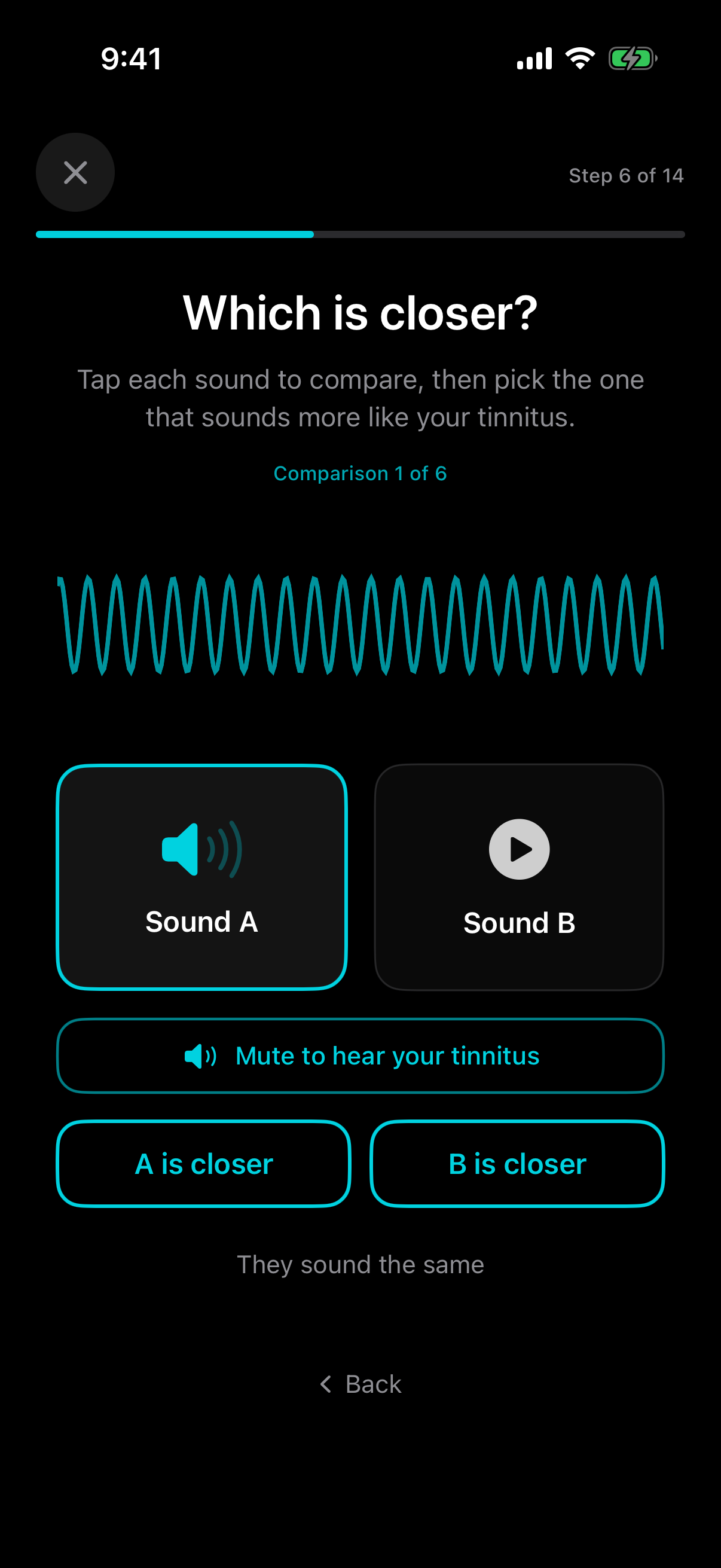
Instead of hunting with a slider, answer a few simple "which is closer?" comparisons. A binary search homes in on your frequency, an octave check catches the most common matching error, and a quick retest scores how reliable your match is.
FreeIf your tinnitus hisses or roars rather than rings, a pure tone can never match it. Hzera matches noise-like tinnitus with band-limited noise instead, capturing both its center frequency and its width.
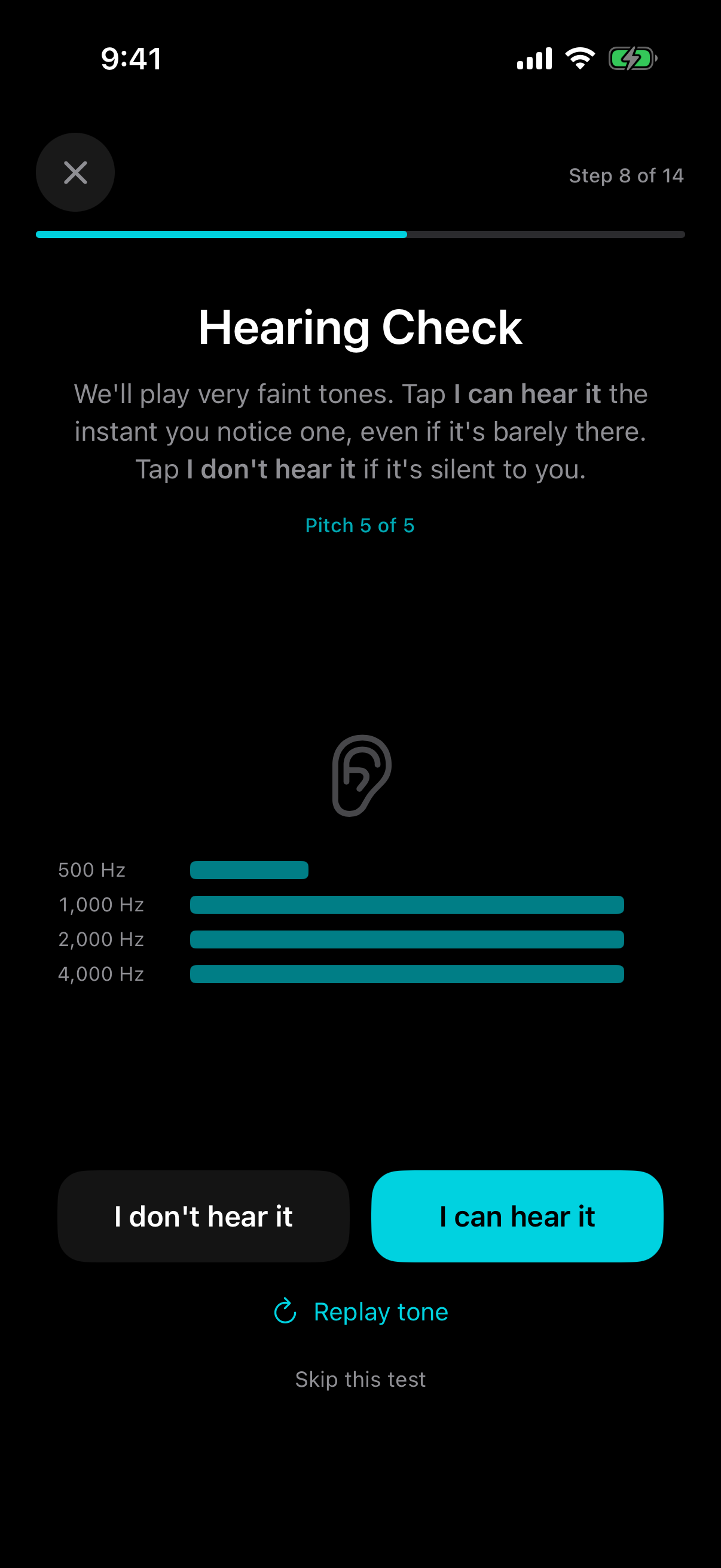
FreeA short pure-tone threshold test across the spectrum shows where your hearing sits and expresses your tinnitus loudness in sensation level, relative to your own threshold rather than an arbitrary scale.
FreeFind the noise level that just covers your tinnitus, then record whether a minute of masking changes it briefly. The result describes your immediate response and is not presented as a prediction of treatment success.
FreeA 10-question impact score across five clinical grades, plus a short hyperacusis (sound-sensitivity) screen and medical red-flag questions that highlight features worth discussing with a doctor.
FreeWhen you finish, one tap sends your matched pitch and notch width straight into your listening settings. The assessment connects what you heard to a personalized starting configuration.
FreeEvery test runs entirely on your device and is screening-grade. Hzera is not a medical device and does not replace an audiologist.
Your score guides personalised recommendations, from self-monitoring to professional referral.
Minimal impact. Monitoring recommended.
Noticed mostly in quiet environments.
Noticeable impact on daily life.
Professional consultation recommended.
Immediate professional support needed.
Each soundscape has your personalised notch applied in real time. Frequency Fit measures source energy around your calibration, while full-file loudness normalization keeps the 24 bundled tracks consistent.
Deep & warm
FreeBalanced
FreeFull spectrum
FreeSteady downpour
FreeWoodland calm
FreeSoft & ethereal
PremiumWarm bloom
PremiumDeep cascade
PremiumAmbient terminal
PremiumBirdsong
PremiumCrackling warmth
PremiumRolling waves
PremiumDistant rumble
PremiumSynthetic pulse
PremiumFlowing water
PremiumLo-fi beats
PremiumSmooth lounge
PremiumOffbeat groove
PremiumGentle rhythm
PremiumWindswept hush
PremiumAiry cascade
PremiumSuspended calm
PremiumHypnotic drone
PremiumMorning warmth
PremiumImport MP3, M4A, WAV & more
PremiumDesigned for daily use, simple enough for a first session, powerful enough for months of therapy.
Full 20 Hz – 20 kHz range with 5 Hz fine-tuning. Quick Tune lets you recalibrate any time your tinnitus changes.
Start with a guided Standard, Broad Range, Related Tones, or Music setup, then adjust compatible width, depth, enhanced edges, and related-frequency controls deliberately.
Hzera measures source energy around your calibrated notch and labels each soundscape Strong, Good, or Limited fit. It guides source choice without pretending to predict an outcome.
Related-frequency banks stay at ½ octave, preventing overlapping wide filters from removing most audible source content.
All data stays on your device. No accounts, no analytics, no tracking. Works entirely offline after install.
Fall asleep to therapy. Set a timer from 15 to 120 minutes; the app holds your therapy level, then gently fades out over the final minute.
Set personalised reminders if a regular listening routine is useful to you.
Weekly trends, streak tracking, total listening time, and detailed soundscape breakdowns to monitor progress.
See your elapsed therapy time directly in the playback bar. Daily goal tracking and streak counters keep you motivated and consistent.
Tap the main button to pause and pick up exactly where you left off. Short breaks don't reset your soundscape or fragment your listening time.
A built-in guide covering calibration, daily use, notch vs CR, headphones, and tracking progress, plus a fresh tip on the dashboard each day.
Fall asleep to the notch soundscape, then let the app cross gently into Coordinated Reset after 30, 45, 60, or 90 minutes and run it through the night.
A deep or wide notch removes real energy from the sound. Hzera compensates the overall level within a safe limit, but volume cannot replace frequency content removed by the filters.
Stream to compatible aids, with one important caveat: their own DSP may reshape the signal after it leaves Hzera. Ask your hearing professional about an appropriate media or music program if exact spectral response matters to you.
CGM alarms, medication reminders, timers, and navigation play over the therapy instead of stopping it. One iOS trade-off: lock-screen controls are unavailable while mixing is on.
VoiceOver, Dynamic Type, and Reduce Motion are supported throughout, across the whole calibration and diagnostic rather than just the front screen. Every control is labelled and selections are confirmed aloud.
No subscriptions. One price. Lifetime access.
Most tinnitus sound apps charge a monthly subscription. Hzera offers adjustable tools informed by published research concepts and charges once.
Core calibration and sound tools at no cost.
Unlock every feature with a single payment.
Research typically measures sound-therapy outcomes over weeks or months, but findings are mixed and there is no guaranteed timeline.
Calibrate carefully, use Guided Setup, choose a sound with useful Frequency Fit, and keep the volume pleasant rather than intense.
Use session history and repeat assessments to compare your own longer-term experience. A streak measures routine, not medical effectiveness.
Some people report benefit from sound tools and others do not. Stop uncomfortable listening and involve a qualified clinician when tinnitus is persistent or concerning.
Listen while working, reading, or relaxing if comfortable background sound fits the activity. Pair it with an existing habit if that helps you remember.
If background sound helps you settle, the Sleep Timer provides a gentle fade and Sleep Mode can transition between listening patterns.
Use headphones to preserve left and right routing. Over-ear headphones can be more comfortable for longer sessions.
The Jastreboff neurophysiological model offers one framework for understanding why tinnitus can become difficult to ignore.
In the 1990s, neuroscientist Dr. Pawel Jastreboff made a breakthrough discovery: tinnitus doesn't persist because of your ears alone. It persists because your brain's emotional and survival systems get involved, turning a faint signal into something impossible to ignore.
Here's how it works. When your auditory system first produces a phantom sound, your brain's limbic system, the part that controls emotions like fear and anxiety, flags it as a threat. Your fight-or-flight response kicks in. Your brain starts paying more attention to the sound, which makes it feel louder, which triggers more anxiety. A vicious cycle takes hold.
Think of it like a smoke alarm that won't stop beeping. The alarm itself isn't dangerous. But the longer it goes off, the more stressed you become, and the harder it is to tune out. Your brain needs to learn that this particular signal is not a real threat.
Hzera provides adjustable listening tools you can use while exploring that process.
Damaged hair cells in the inner ear, or overactive neurons, produce a phantom sound. On its own, it's faint and harmless.
Your limbic system labels the sound as important. Stress hormones fire. Your brain starts actively listening for it, making it louder and harder to escape.
Attention and anxiety feed each other. The more you notice the ringing, the more your brain amplifies it. This loop is what makes tinnitus feel relentless.
Habituation-based approaches explore whether repeated, comfortable sound exposure can help tinnitus become less attention-grabbing over time. Individual experiences vary.
These features draw from different research concepts. They are transparent, adjustable sound tools—not a claim that three mechanisms automatically produce a clinical result.
Hzera removes a calibrated band from the source audio. Lateral inhibition is one proposed mechanism explored in small studies; results across clinical research remain mixed.
Comfortable background sound can reduce the immediate contrast between tinnitus and silence. Some people find that useful for relaxation, focus, or sleep; experiences differ.
Four tones at precise offsets around your frequency are delivered in varied sequences. The pattern is based on an experimental neural-desynchronization concept whose lasting clinical benefit remains under study.
Protecting your hearing matters whether or not you use sound tools. Everyday noise habits can help reduce avoidable exposure.
A typical concert hits 100–115 decibels. At that level, permanent hearing damage can start in under 15 minutes. Clubs, festivals, sporting events, even movie theatres: any environment where you have to shout to be heard is loud enough to cause real harm.
The damage is cumulative and invisible. You won't feel it happening. But each exposure kills more of the delicate hair cells in your inner ear, cells that can never grow back. Over time, this hearing loss can trigger or worsen tinnitus.
The good news? A quality pair of earplugs changes everything. Modern earplugs reduce volume evenly across all frequencies, so the music still sounds great, conversations are still clear, but your ears are protected.
We recommend Loop earplugs for concerts, festivals, clubs, and any persistently loud environment. They use acoustic filters to reduce volume while preserving the full richness of the sound around you.
Everything you need to know about calibration, therapy, and getting the most out of Hzera.
The Full Diagnostic is a guided, self-administered battery that characterizes your tinnitus in about 12 minutes, entirely on your device. It matches your pitch (for tonal tinnitus) or a band of noise (for hissing and roaring), runs a hearing-threshold screen, finds the level that just masks your tinnitus, tests for residual inhibition, and screens for sound sensitivity and medical red flags. When you're done, one tap can apply your matched pitch and notch width to your therapy.
It is screening-grade, meant to guide your therapy and track changes over time. It is not a calibrated audiogram or a medical diagnosis, and it does not replace an audiologist or ENT specialist. If your tinnitus is sudden, one-sided, pulsing, or accompanied by hearing loss or dizziness, please see a doctor. A quick 3-minute assessment is also available when you just want a fast check.
Calibration is a two-stage process designed to pinpoint your exact tinnitus frequency. Before you start, put on wired or Bluetooth headphones, find a quiet room, and set your device volume to a comfortable low level.
You can recalibrate at any time from the Tune button on the main screen.
Yes. Hzera's notch filter is tuned to your exact tinnitus frequency, and headphones deliver that filtered signal precisely to each ear. Speakers won't give you the same effect because the sound mixes with the room acoustics before it reaches you.
Either wired or Bluetooth headphones work fine. Over-ear models tend to be comfortable for longer listening sessions.
Hzera can stream to compatible Bluetooth hearing aids, but a hearing aid's own digital signal processing may reshape the audio after it leaves the app. Depending on the fitting, that can include frequency lowering, compression, noise reduction, or feedback control.
If exact spectral output matters to you, ask your hearing professional whether a media or music program is appropriate. Hzera cannot bypass or measure processing performed by the hearing aids.
Published studies use varied schedules, and there is no universally proven daily dose. Choose a comfortable routine you can sustain and follow professional guidance if you have it.
You can listen while working, reading, exercising, commuting, or relaxing when background sound is comfortable and safe for the activity.
Published studies commonly measure outcomes over weeks or months, but the evidence is mixed and no individual timeline can be predicted.
Tracking sessions and re-taking the built-in assessment can help you compare your own longer-term trend. These records do not prove that a listening mode caused a change.
Notch mode removes a narrow band around your calibrated frequency. Published studies have explored lateral inhibition as a possible mechanism, but findings are mixed.
Coordinated Reset (CR) presents four short tones around your frequency in varied order. It is based on an experimental neural-desynchronization concept.
You can switch modes at any time. Compare comfort rather than trying to maximize intensity, and stop a mode that feels unpleasant.
Yes. Tapping the main playback button pauses the soundscape and resumes it from exactly where you stopped, with no need to restart from the beginning. Your current session keeps tracking through the pause, so short breaks won't fragment your listening time.
Lock-screen and Control Center pause/play controls work the same way.
Premium is a one-time unlock, not a subscription. It adds:
Premium is shared through Family Sharing, so everyone in your family group gets access.
Mostly the price model and feature set. Hzera Premium is a single $4.99 purchase, which is less than one month of many subscription apps, and it includes both listening modes, the full diagnostic, per-ear processing, guided advanced notch controls, custom audio import, and Family Sharing.
The free tier includes the diagnostic, full calibration, real-time notch filtering, and five soundscapes, so you can evaluate the experience before purchasing.
Yes, in three ways:
Choose Deep to completely remove sound exactly at each selected frequency, or Soft for a −12 dB center reduction with the same two-sided boundaries. The live spectrum labels every active notch and updates immediately. All three options are Premium features.
Tinnitus can shift, sometimes day to day. If you notice the tone you calibrated to no longer matches what you hear, just tap Tune and recalibrate; it only takes a couple of minutes. For small adjustments, use Quick Tune to nudge the frequency in fine increments without re-running the full calibration.
Premium users can save multiple profiles and switch between them if your tinnitus has recurring patterns.
Related Frequency Notches remove several bands from the source instead of one. Depending on the soundscape, that can make the result naturally thinner or less full. Hzera compensates the overall playback level within a safe limit, but added volume cannot replace frequency content that the filters removed.
A quieter or thinner result does not mean the setting is stronger or more effective. Use Frequency Fit as a source-content guide, compare sounds at a comfortable level, and choose the combination you prefer.
No. Hzera is privacy-first. Everything, including your calibration, profiles, session history, and assessment results, is stored locally on your device. We don't operate an account system, don't sync to the cloud, and don't track you. There's no analytics SDK in the app.
See our Privacy Policy for full details.
No. Hzera is not a medical device and does not diagnose, treat, or cure tinnitus or any other condition. It's a sound tool informed by published research into notch filtering and Coordinated Reset patterned listening.
If your tinnitus is severe, sudden, or accompanied by other symptoms, please consult an audiologist or ENT specialist. Hzera is not a substitute for professional care.
Have a question, found a bug, or need guidance with your therapy? Reach out any time.
We aim to respond within 24 hours.
Hzera is not a medical device and does not diagnose, treat, or cure tinnitus. If your tinnitus is severe, sudden, or accompanied by other symptoms, please consult an audiologist or ENT specialist. Hzera is not a substitute for professional care.